India’s device landscape is one of the most complex in the world for software developers to target. The installed base spans flagship Android handsets and budget devices three generations old, iPhones running current iOS and older models never updated beyond a certain version, and a non-trivial Windows desktop and laptop user base that becomes particularly relevant in smaller cities and semi-urban households where a shared family computer remains the primary screen. Platforms that want to reach the full breadth of India’s active digital population cannot afford to optimise for one device category and neglect the rest. Maxwin casino — offering dedicated Android and iOS apps alongside a Windows desktop client downloadable directly from its site at, and supporting INR accounts with PhonePe, PayTM and UPI — illustrates what a genuine multi-platform delivery strategy looks like when it is built around India’s actual hardware reality rather than an idealised version of it.
Why Android Alone Is Not Enough
The reflexive assumption in discussions of India’s mobile market is that Android is the whole story. Android’s dominance in India is real — its market share among smartphone operating systems is overwhelming by any measure. But that framing obscures two important realities.
First, the Android installed base in India is not homogeneous. It spans devices with radically different processor capabilities, RAM configurations, screen resolutions and storage capacities. An APK optimised for a Snapdragon 8 series chipset may run poorly on a MediaTek entry-level processor that represents a far larger share of actual devices in use. Platforms distributing Android apps directly from their own sites — rather than through the Play Store — retain control over build configuration and can optimise more aggressively for the mid-range and budget device profiles that dominate the Indian market.
Second, direct APK distribution matters for a specific reason in India: Play Store availability cannot be guaranteed for all content categories. Platforms that host their own Android APK downloads sidestep distribution dependencies that could otherwise interrupt user access — a practical resilience advantage that Indian users in this category have come to treat as a baseline expectation.
The iOS Challenge and the PWA Solution
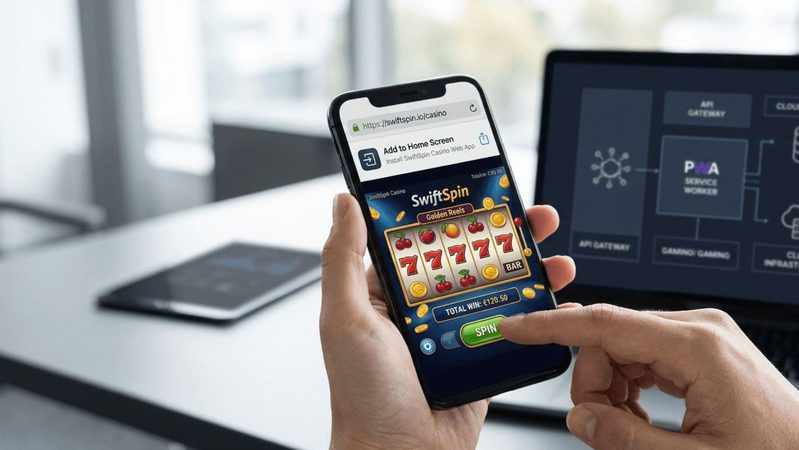
iOS presents a different set of constraints. Apple’s App Store review policies create approval uncertainty for certain content categories, and the process of maintaining a listed app requires ongoing compliance with policies that can change. For platforms serving Indian users on iPhones — a segment that punches above its weight in urban, higher-income demographics — the typical solution is a Progressive Web App delivered through Safari’s Add to Home Screen functionality.
The iOS PWA approach is not a compromise — it is a deliberate architectural choice. A PWA installed to the iPhone home screen behaves like a native app from the user’s perspective: it launches from the same place, runs full-screen, and operates without the browser chrome visible. The underlying technology is web-based, which means updates deploy instantly without requiring an App Store submission cycle and the app inherits browser-level performance optimisations that Apple has continued to improve across iOS versions.
Windows as an Underestimated Channel

The Windows desktop client is the least-discussed component of a multi-platform strategy for India but arguably the most differentiated. Most international gaming platforms targeting India focus exclusively on mobile. The subset that also serves Windows desktop users is smaller — and that creates an opportunity.
India’s Windows user base skews toward specific demographics: students using college-issued or family computers, professionals in smaller cities where desktops remain common home computing devices, and users who simply prefer a larger screen for extended sessions. These are not edge cases — they represent a meaningful and underserved audience segment that mobile-only platforms leave unaddressed by default.
A Windows client also enables a qualitatively different gaming experience for titles where screen real estate matters: live casino games with multiple simultaneous camera feeds, blackjack tables where card visibility is improved on a larger display, and game show formats where the spectacle is enhanced by more pixels. Maxwin’s game library — which includes 528 live casino titles, 342 blackjack variants, and 99 roulette games across formats — translates particularly well to the larger display a desktop client enables.
The Loyalty Infrastructure That Ties It Together
Multi-platform delivery creates a technical challenge that is easy to overlook: ensuring that the user experience — account state, balance, bonus status, transaction history — is consistent and synchronised regardless of which device the user is accessing from. A user who deposits on mobile and wants to play on desktop should encounter no friction at that transition.
The MaxWin Coins loyalty programme — which accumulates points across casino and sports wagers and converts them to real money at defined exchange rates in INR — is an example of infrastructure that only works if platform continuity is genuinely solved. A loyalty system that resets or fails to track activity across devices is not a loyalty system; it is a source of user frustration. Getting this layer right technically is a prerequisite for any cross-platform engagement strategy that aims to build retention rather than just acquisition.